Anxiety, Trauma and Addiction: Two Sides of the Same Psychological Loop
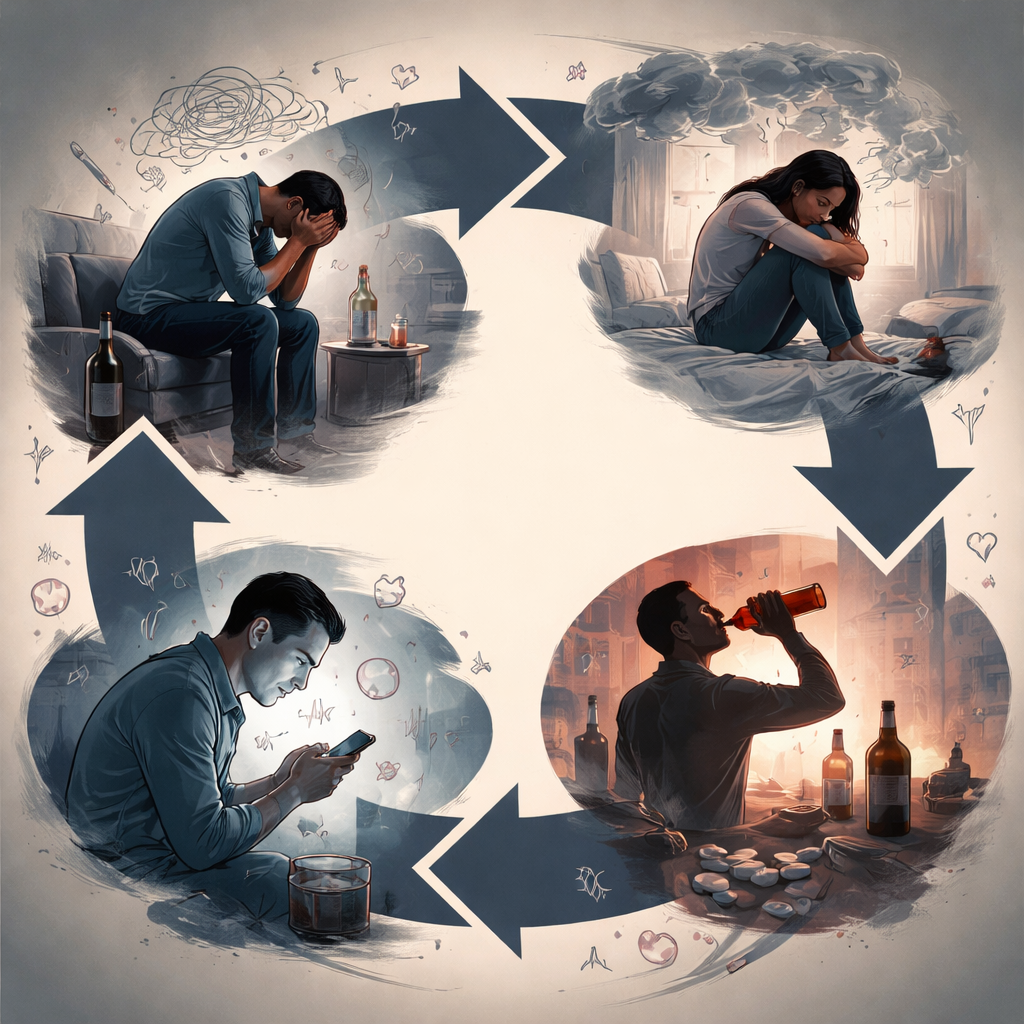
Most people assume that anxiety, PTSD and addiction belong in separate categories.
Different causes, different treatments, different stories.
In reality, they are often deeply intertwined.
In clinical work, these states rarely appear in isolation. Instead, they form a psychological loop, a system in which the mind and body learn patterns that feel protective in the short term but gradually become destructive. What begins as coping quietly evolves into compulsion. What once felt like survival becomes a trap.
There are two common ways people enter this loop.
For some, the story begins with substances. Alcohol or drugs are initially used to relax, to cope, to soften the edges of life. At first, they work. The mind slows, the body loosens, the relentless pressure eases. But over time, the nervous system begins to fray. Sleep becomes fragmented. Mood becomes unstable. Emotional resilience erodes. Gradually, anxiety creeps in, followed by low mood, shame, self-criticism and a growing fear of losing control.
The substance that once offered relief becomes the very engine of distress.
For others, the sequence runs in the opposite direction. They begin not with substances, but with anxiety itself. They are vigilant, perfectionistic, emotionally overloaded. They may carry the imprint of trauma, instability or simply years of unrelenting responsibility. Their minds are busy and analytical, their bodies rarely at ease. Eventually, alcohol or drugs enter the picture, not as rebellion, but as medication. A way to quiet the mind, soften fear, escape relentless self-monitoring, or feel normal for a brief moment.
Here, substances are not the original problem. They are the attempted solution.
What is rarely discussed is that emotional states themselves can become addictive. Not in a dramatic or moralistic sense, but in a neurological and behavioural one. The brain learns familiarity. Anxiety becomes a default setting. Gloom becomes a psychological identity. Catastrophic thinking masquerades as control. Hyper-vigilance is mistaken for safety.
People do not enjoy these states, but they become strangely attached to them because they are known, predictable and oddly stabilising. Distress becomes familiar territory.
This is why simply removing alcohol or drugs so often fails to resolve the deeper issue. Without psychological restructuring, the mind usually finds another outlet: health anxiety, compulsive thinking, emotional withdrawal, sugar dependence, overworking, perfectionism. The behaviour changes, but the underlying pattern remains intact.
Cognitive Behavioural Therapy addresses this at its root.
CBT is not about positive thinking or superficial coping strategies. It is about exposing and dismantling the invisible architecture that holds anxiety and addiction in place. It helps clients understand how thoughts, emotions and behaviours reinforce each other, how anxiety quietly tips into compulsion, and how substances become tools for regulating unbearable internal states. It retrains the nervous system to tolerate discomfort without chemical escape and replaces unconscious survival strategies with conscious psychological choice.
Instead of endlessly asking, “Why am I like this?”, CBT reframes the question into something far more empowering:
What has my mind learned to do, and how can I unlearn it?
For many clients, this is a pivotal realisation. Anxiety and addiction are not personal flaws or moral failures. They are conditioned patterns. And conditioned patterns can be changed.
Traditional approaches often treat substance misuse and anxiety as separate problems. Clinically, this is a mistake. Address drinking without addressing anxiety, and anxiety often intensifies. Address anxiety without addressing substance use, and the coping mechanism remains untouched. Meaningful change happens only when both sides of the loop are understood together.
At Harrogate Sanctuary, CBT is used not simply to stop harmful behaviours, but to dismantle the psychological machinery that drives them. The aim is not merely sobriety or calm, but something more profound: psychological freedom from patterns that once felt inevitable.
